Ever see a cool anime character and wish you could draw it yourself? I get it. Drawing can seem daunting, especially if you’re just starting out.
Many people think drawing anime is too difficult for beginners. But here’s the truth: it’s all about starting with simple shapes. Anyone can do it with a bit of guidance.
This guide will break down the process of creating a sketsa lukisan anime simple into easy, manageable steps that anyone can follow. We focus on foundational techniques used by artists, not complicated shortcuts that don’t work.
By the end of this article, you’ll have the basic skills and confidence to sketch your first simple anime face. Trust me, it’s not as hard as it looks.
Gathering Your Gear: The Only Tools You Really Need
Keep it simple and accessible, and you don’t need expensive art supplies. Start with a standard #2 pencil, a good eraser, and plain printer paper.
Why these tools? The #2 pencil is perfect for light initial sketches and darker final lines. A vinyl or kneaded eraser won’t smudge your work.
Avoid common beginner mistakes. Don’t buy a 50-piece art kit before learning the basics. Skill, not tools, is the most important thing.
For those who prefer digital, a simple tablet and a free drawing app like Krita or Ibis Paint X are great starting points.
The goal is to remove barriers and get you drawing immediately with things you likely already have.
Pro tip: Focus on practicing sketsa lukisan anime simple to build your skills.
The Foundation: Building an Anime Head with Simple Shapes
Every complex drawing starts with basic geometric shapes. We’ll use a circle and a triangle.
Start by lightly sketching a circle for the top part of the head. Then, draw a simple, slightly curved V-shape below it for the jaw and chin.
Draw a vertical line down the middle of the face and a horizontal line across the middle. This is where the eyes will go.
The nose is typically halfway between the eye line and the chin. The mouth is a small line just below the nose.
Sketch lightly at first. These are ‘construction lines’ that you will erase later, so don’t press down hard.
Pro tip: Anime faces are often less round than real faces, so don’t be afraid to make the chin pointier than you think.
Using sketsa lukisan anime simple techniques, you can create a solid foundation for your character. This method helps in achieving the right proportions and features, making your drawing look more polished and professional.
Adding Personality: Sketching Iconic Anime Eyes and Hair
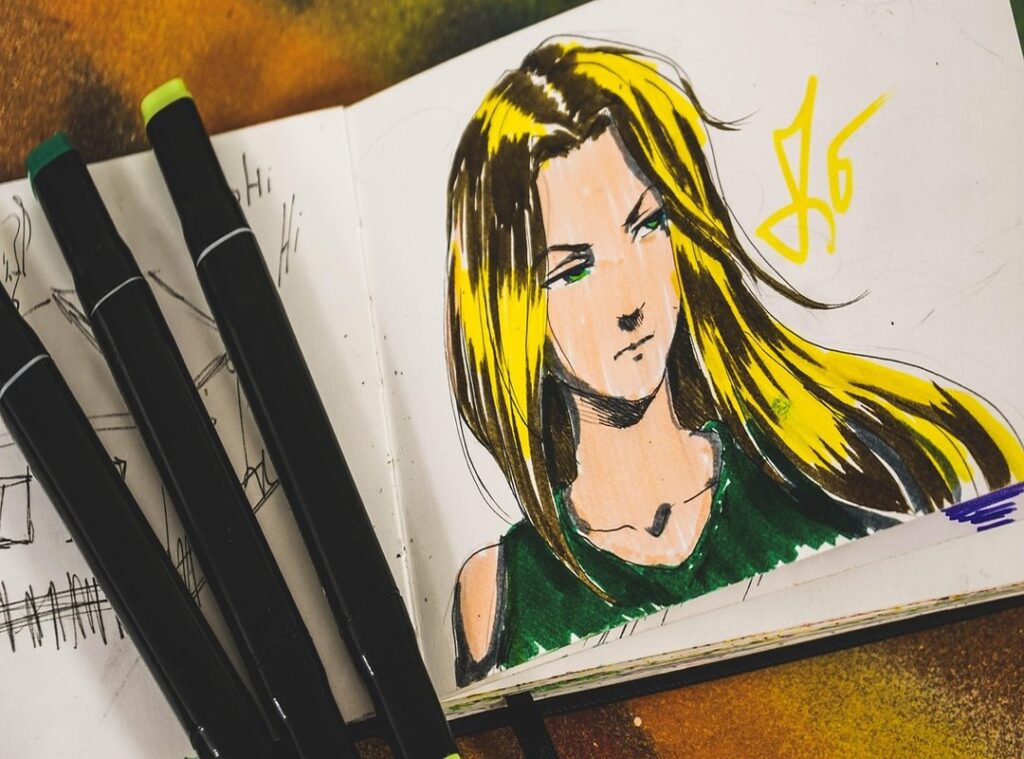
When it comes to adding personality to your anime characters, the eyes are the most expressive feature. Simple anime eyes are made of a thick, curved upper lash line and a thinner, shorter bottom line.
Inside the eye shape, draw a large oval for the iris. Inside that, add a smaller circle for the pupil. Leave a small, uncolored white circle to create a ‘shine’ effect.
This little detail can make your character’s eyes pop. sketsa lukisan anime simple
Now, let’s talk about hair. The biggest rule of anime hair is to draw it in large, chunky sections or clumps, not individual strands. Start by defining the hairline on the forehead.
From there, sketch the basic shapes of the bangs and the hair flowing down the sides and back.
Use overlapping shapes to create depth, and curved lines can suggest movement and volume. This makes the hair look more natural and dynamic.
Experiment with different styles. Changing the shape of the eyes or the style of the hair can completely change the character’s personality. For example, larger, rounder eyes might give a character an innocent, youthful look, while sharper, narrower eyes could make them seem more mature or serious.
Remember, sketsa lukisan anime simple is all about keeping things straightforward and clean. Don’t overcomplicate it. With a bit of practice, you’ll be able to create unique and expressive characters in no time.
Quick Fixes: 4 Common Beginner Mistakes and How to Avoid Them

Let’s be real, starting out in drawing can be a bit of a rollercoaster. You’re excited, but also nervous about making mistakes. I get it.
Here’s a quick rundown of the most common beginner pitfalls and how to dodge them.
First up, ‘Floating Head Syndrome’, and this one drives me nuts. It’s when you draw a head without any neck or shoulders.
Always sketch a simple neck and the top of the shoulders. It grounds your character and makes them look more natural.
Next, pressing too hard, and trust me, I’ve been there. Your initial sketches should be very light.
This way, you can easily erase and correct without damaging the paper. It’s a small tip, but it makes a huge difference.
Misaligned features are another biggie. This happens when you skip drawing the guidelines. The center and eye lines are crucial for a balanced face.
Don’t skip this step. It’s like the foundation of a building; without it, everything falls apart.
Making the eyes too small is a classic mistake, especially in anime. Anime is known for large, expressive eyes. So, go ahead and slightly exaggerate their size compared to a realistic drawing.
It adds that extra oomph and makes your sketsa lukisan anime simple stand out.
By keeping these tips in mind, you’ll avoid some of the most common beginner mistakes and start seeing real progress in no time.
Your Journey as an Anime Artist Starts Now
You’ve learned that any sketsa lukisan anime simple can be broken down into basic shapes, guidelines, and key features. This understanding is the foundation of your artistic journey. The initial goal has been met: you now have a complete, step-by-step method for drawing a simple anime face.
Practice is the most important tool. Remember, the first sketch won’t be perfect, and that’s the whole point. Grab your pencil right now and try sketching your favorite character using the shape method we just covered.
 Williamer Andersoniston has opinions about esports coverage and updates. Informed ones, backed by real experience — but opinions nonetheless, and they doesn't try to disguise them as neutral observation. They thinks a lot of what gets written about Esports Coverage and Updates, Gaming News and Trends, Game Reviews and Ratings is either too cautious to be useful or too confident to be credible, and they's work tends to sit deliberately in the space between those two failure modes.
Reading Williamer's pieces, you get the sense of someone who has thought about this stuff seriously and arrived at actual conclusions — not just collected a range of perspectives and declined to pick one. That can be uncomfortable when they lands on something you disagree with. It's also why the writing is worth engaging with. Williamer isn't interested in telling people what they want to hear. They is interested in telling them what they actually thinks, with enough reasoning behind it that you can push back if you want to. That kind of intellectual honesty is rarer than it should be.
What Williamer is best at is the moment when a familiar topic reveals something unexpected — when the conventional wisdom turns out to be slightly off, or when a small shift in framing changes everything. They finds those moments consistently, which is why they's work tends to generate real discussion rather than just passive agreement.
Williamer Andersoniston has opinions about esports coverage and updates. Informed ones, backed by real experience — but opinions nonetheless, and they doesn't try to disguise them as neutral observation. They thinks a lot of what gets written about Esports Coverage and Updates, Gaming News and Trends, Game Reviews and Ratings is either too cautious to be useful or too confident to be credible, and they's work tends to sit deliberately in the space between those two failure modes.
Reading Williamer's pieces, you get the sense of someone who has thought about this stuff seriously and arrived at actual conclusions — not just collected a range of perspectives and declined to pick one. That can be uncomfortable when they lands on something you disagree with. It's also why the writing is worth engaging with. Williamer isn't interested in telling people what they want to hear. They is interested in telling them what they actually thinks, with enough reasoning behind it that you can push back if you want to. That kind of intellectual honesty is rarer than it should be.
What Williamer is best at is the moment when a familiar topic reveals something unexpected — when the conventional wisdom turns out to be slightly off, or when a small shift in framing changes everything. They finds those moments consistently, which is why they's work tends to generate real discussion rather than just passive agreement.